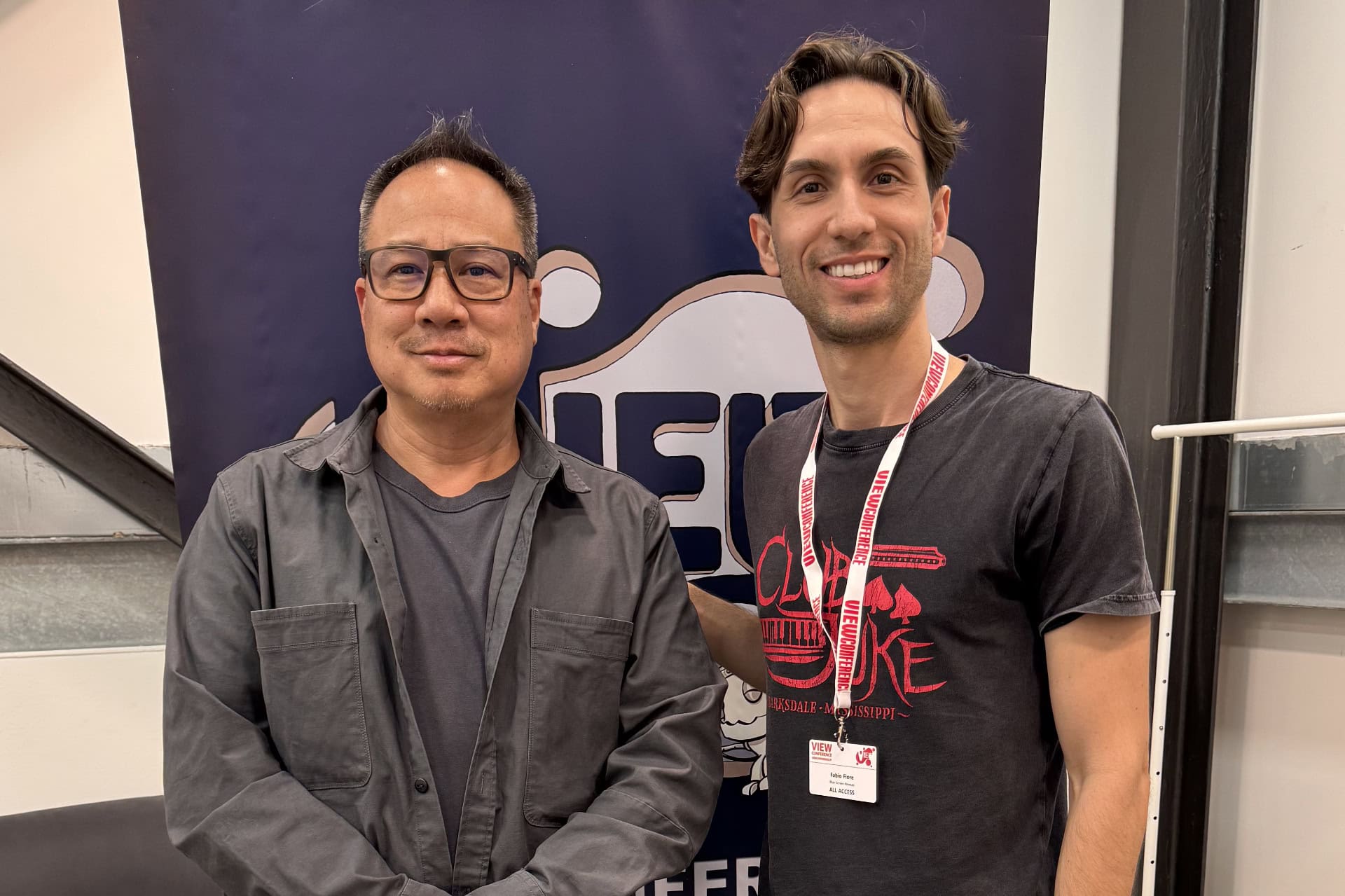
Jerome Chen: Showcasing Peter Parker’s Transformation Through VFX in Spider-Man: Brand New Day
VFX supervisor Jerome Chen focused on the development of Peter Parker’s transformation in Spider-Man: Brand New Day, diving into the evolution from synthetic to organic webs to his close collaboration with Tom Holland–creating a grounded physicality for the character.

This interview was conducted in partnership with VIEW Conference. Jerome Chen was a featured speaker at VIEW Conference 2026 in Turin, Italy.
Spider-Man’s latest theatrical chapter, Brand New Day, brought a much more intimate story compared to the more large-scale, Avengers-style epics of its predecessors. The film deeply connects to the choices made in No Way Home; the aftermath of Peter’s spell that hid once again his true identity as Spider-Man–especially to his friends–is consuming him. The lost connection with Ned and MJ is forcing him to be more Spider-Man than Peter Parker, and while his performance as protector of New York is outstanding, he’s losing himself to a point where his body starts to mutate into something terrifying. The monster inside of him cannot be tamed, and Peter begins to lose control and experience a change that he will eventually have to come to terms with. VFX supervisor Jerome Chen, whose experience with the friendly neighborhood Spider-Man dates back to Andrew Garfield’s duology, was excited to dive into a more street level, grounded story focused on Peter Parker.
This biological transformation is at the center of Brand New Day. Peter’s rough patch of his life, his depression and identity detachment are suddenly shifting him closer to an arachnid (similar to Tobey Maguire’s version of Spider-Man), losing control of his new powers. “There are a couple of levels of character arcs happening here … there’s the internal arc that [Tom Holland] is giving us, and then there’s the visual storytelling that we have to do to help convey what his transformation is. A simple version of that is the eyes … you see his eyes turn black. Most spiders’ eyes are very shiny, very reflective, so that was a very easy thing to accomplish that we only did two or three times.” Jerome Chen then dove into the crux of the change–his webs, “which are vital to explain what happens to Spider-Man in this film. In the beginning of the movie he’s using artificial webs that he’s made … they shoot out of a device that he has to wear, they’re very clean, very geometric, they look metallic, like steel. As he starts to undergo this physical transformation, he cannot use the artificial webs in combination with his organic webs. The organic webs in the beginning are very messy … they’re translucent, they’re gooey, and they’re not controlled.”
“When people see spider webs, they want to brush them aside … there’s a sense of revulsion about them. If you look at all the different types of webs that real spiders create, they’re cocoon-like, they’re very thick, and so we wanted to make sure we had an organic look that wasn’t too grotesque.”
Creating Spider-Man’s new webs and their transition from synthetic to organic in Brand New Day was a deeply involved process that required the right balance between functionality and style. Chen explained, “For the artificial webs, we came up with a pattern that was similar to what we’ve seen in the other movies because we didn’t want to diverge too much. The last time that Spider-Man used webs, they were based on Stark technology, and those were very sophisticated, but now he doesn’t have access to that, so we created a look that was reminiscent but different enough to realize that he’s made his own type of webs.” On the other hand, for the organic webs, the VFX supervisor revealed that the team had to research spiders in nature: “Inherently, spider webs are not considered beautiful. When people see spider webs, they want to brush them aside … there’s a sense of revulsion about them. If you look at all the different types of webs that real spiders create, they’re cocoon-like, they’re very thick, and so we wanted to make sure we had an organic look that wasn’t too grotesque. It was really difficult to nail that down as a 2D drawing … It really needed to be done in 3D effects. The different visual effects companies came up with tests, and we arrived at a look that I think worked pretty well.” When Peter finally starts web-swinging with his new powers, it’s a steep learning curve, but when he is finally able to tune in, the result is a true spectacle that culminated in the prison battle against The Hand with a beautiful tornado of webs–which Chen described as a “visual symbol of the fact that he’s accepted both sides of himself.”
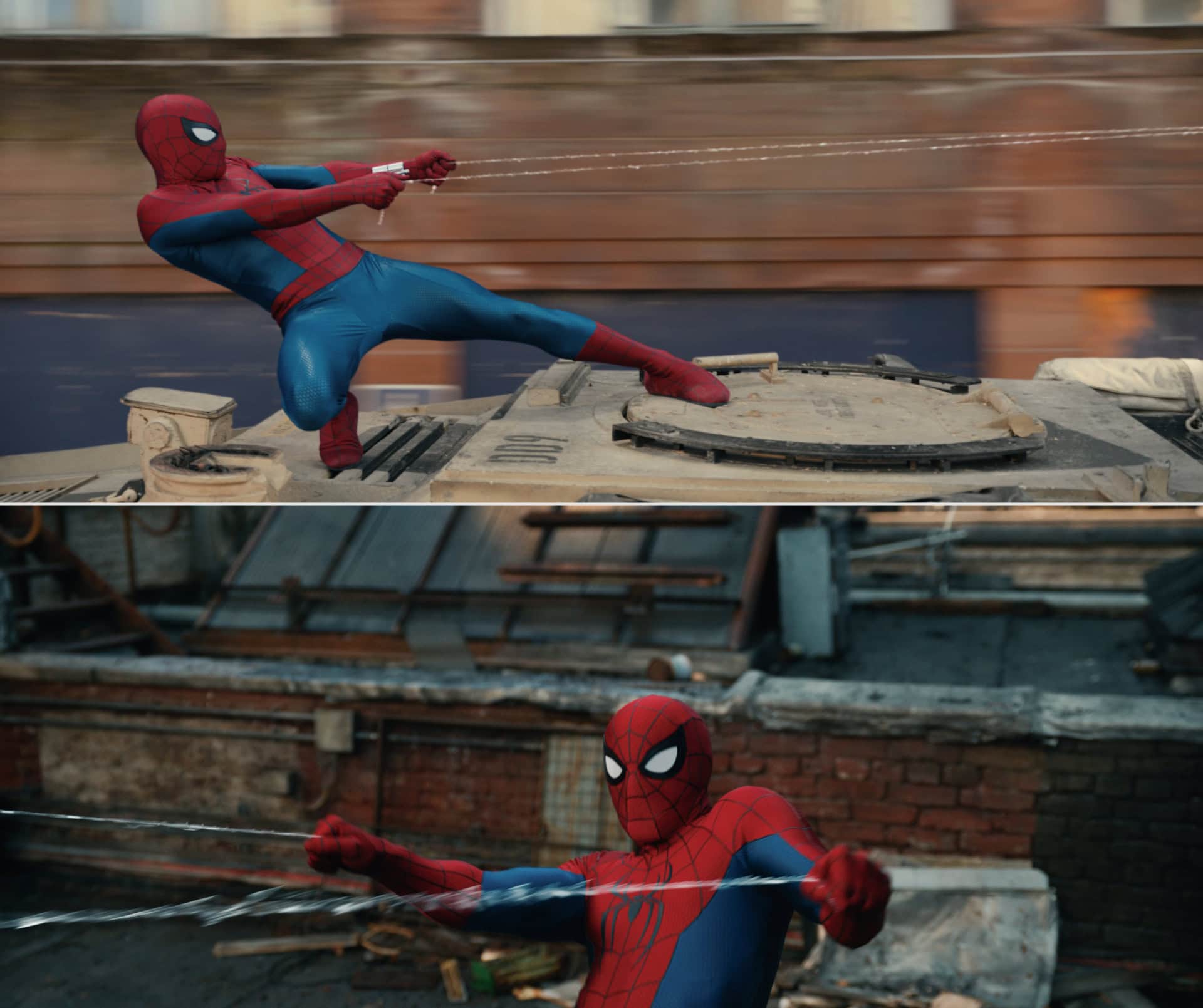
Spider-Man’s physicality might seem like it could be trademarked, but Jerome Chen explained that it’s different in every film. Sure, there is always a commonality in his movements (and some of Spidey’s iconic poses from the classic comics have been showcased in the film), but each director has their stylistic choice–whether it looks and feels effortless or more physical and less refined like in Brand New Day. “It’s difficult [to create his physicality] because you’re trying to imagine a person who is ten times stronger, and when he’s swinging and holding onto the web, that line takes the weight and it’s going to jerk you around, so he has to obey physics. You have to imagine that he has really strong joints, but when he falls, he’s going to fall at the same rate as everything else does. In this movie, the swinging may have felt different because we didn’t do very quick swinging. If he had to swing down the street, we would give him the time to shoot the web. It takes a little bit longer for him to take the weight and do the swing, and then you have him looking around for where he’s going to shoot the next web,” he shared.
Chen revealed his close collaboration with Tom Holland in shaping Spider-Man’s personality through his movement–the psychology behind every decision that reflected his physicality: “His performance is at a different level [in Brand New Day]. He embodies the character not just as Spider-Man but as a man struggling to learn and be comfortable with himself … he was able to convey that in every instance. He was a really good partner and had a lot of great ideas. He was very involved in talking about what Spider-Man would do. It was great to have somebody create a touchstone for us.” The actor’s experience embodying Peter Parker and Spider-Man throughout the years truly helped Chen’s VFX team translate the character’s growth, struggles, and ultimately acceptance on the silver screen, giving the audience a much needed personal insight on a beloved character like never before.
The VFX of Spider-Man: Brand New Day undoubtedly delivered at an epic scale, but what Jerome Chen’s team created for Peter Parker’s transformation is the perfect example of how effective this craft can be in visually translating subtle key aspects of storytelling into something truly spectacular. If you missed his talk at VIEW Conference 2026, you can still experience it on-demand starting next month!