Edward Douglas: Recreating the Backrooms Through VFX
Edward Douglas entered the liminal spaces of Backrooms once again, diving into the creative process to translate Kane Parsons’ YouTube series onto the silver screen.

This interview was conducted in partnership with VIEW Conference. Edward Douglas will be a featured speaker at VIEW Conference 2026, taking place October 12–16 in Turin, Italy.
Kane Parsons’ liminal world of the Backrooms has intrigued the internet with its YouTube found footage, uncovering a stark layer of reality that is as familiar as it is unknown. That same world made the jump to the silver screen this year, bringing these uncanny environments into reality through the eyes of Clark and Mary. The two protagonists took the audience on a journey of mystery, self-discovery, and ultimate dread as they explored buzzing, fluorescent-lit mazes made of old yellow wallpaper and moist carpets. The visual effects department for the feature film was the fulcrum of the project because the original YouTube series was predominantly made by Parsons using Blender–an open-source 3D computer graphics software. Their momentous task of translating those artificial environments onto the big screen involved not only their fully digital recreation, but also combining and extending what was built practically, all with a strong attention to detail–needed for the unforgiving brightness and geometry of the Backrooms. VFX supervisor Edward Douglas revealed the technical challenges of supercharging Kane Parsons’ vision for the theatrical release, sharing his close collaboration with the director then diving into wall clipping and the behind the scenes of some of the key moments of the film.
Translating the YouTube Backrooms Into a Cinematic Experience
In order to test out style and movement for a close to real liminal space, Douglas, Parsons, and the rest of the team did a two-day shoot in an old abandoned department store in Vancouver. This was a chance for the director to start collaborating with the team while understanding the technicalities of taking his digital world into a practical level. The location had beige walls with overhead fluorescent lights, which helped the team realize that “doing a white balance shift to make everything yellow was not going to give us the kind of cinematic feel we wanted for actors to look their best while still feeling like the Backrooms.” Douglas added that the test shoot was of incredible value, providing an idea of how they could achieve the right balance between practical and digital: “It was a big process involving visual effects, but also deeply involving production design and cinematography. Those early test shoots were very educational. I’m always the first person in a production meeting saying, ‘Well, can this be real? Why do we need visual effects? Can we build this?’ I jokingly call it defensive visual effects supervision … I’m there to make sure we don’t need to do visual effects if we don’t have to.” For Backrooms, production built 30,000 square feet of set, although Kane Parsons wanted three times more to complete his vision. That’s where Douglas’ team was able to further extend the seemingly endless mazes–but it was not just about traditional visual effects.
“The look of this world is so stark, surreal, uncanny and static … the way the light falls is so smooth in a way you almost never see in real life. It was a really interesting challenge to build [the Backrooms].”
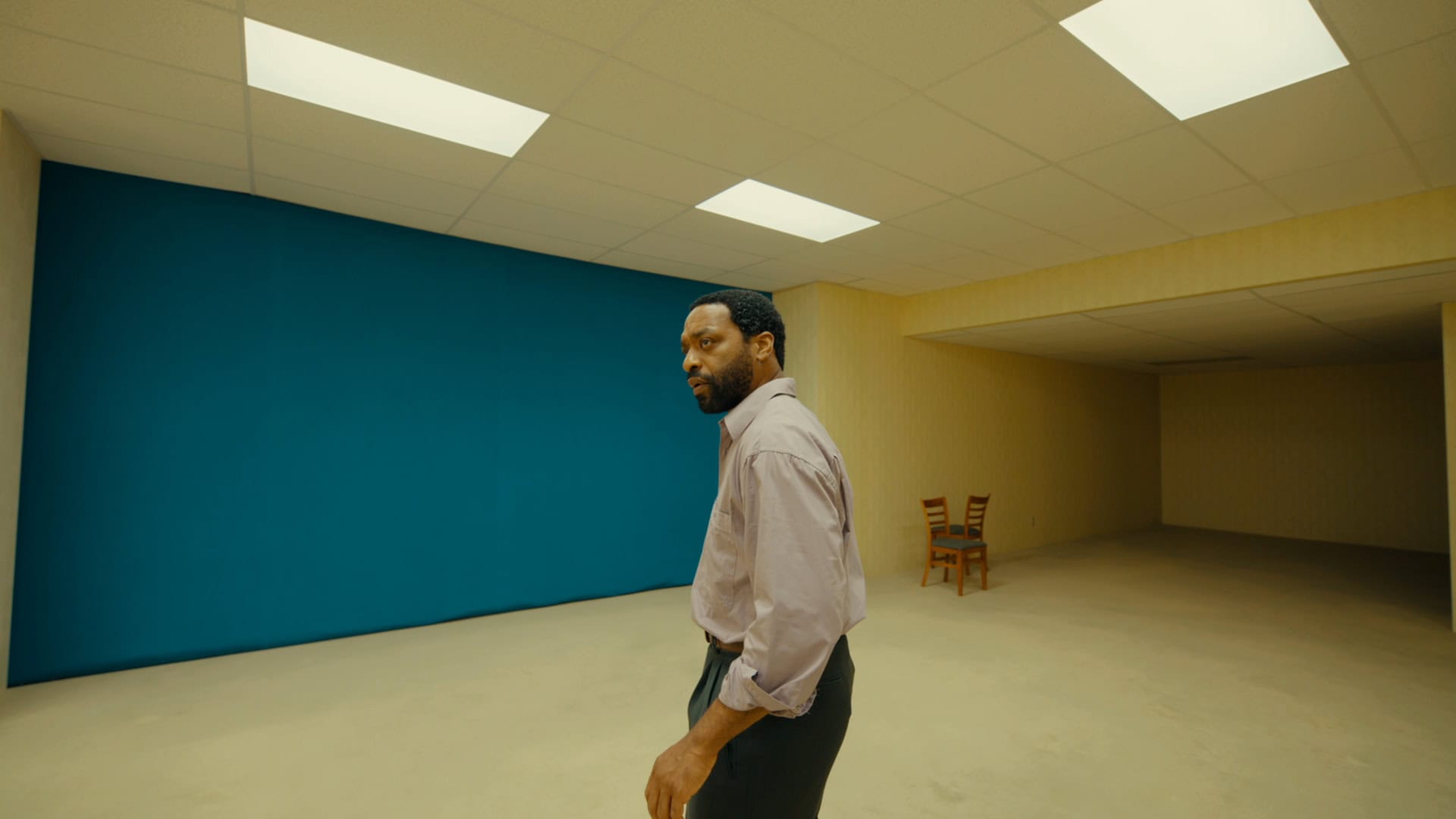
Recently, there has been an amazing intertwinement between practical and digital in cinema, where one compliments the other, and it’s often hard to find the invisible VFX. This was the case for Backrooms, but long before the audience experienced it in theaters. Edward Douglas confessed that there were times when it was challenging to tell apart a CG hallway from a practical one and vice versa, which often made building VFX for Backrooms a surreal experience: “We were walking through all the hallways on set … If we knew Clark wasn’t going to walk down that hallway, we would put a blue screen there–we had to because the stage ended. And then [in post-production] we reproduced our real world Backrooms look–those exact colors, wallpapers, carpets, the way the light falls–recreating that feeling of the Blender PBR (Physically Based Rendering). The challenge was that we might look at that and say, ‘That background looks CG’, but then we would look at the foreground, which is perfect production footage right out of the camera, and also think it’s CG!” He added, “The look of this world is so stark, surreal, uncanny and static … the way the light falls is so smooth in a way you almost never see in real life. It was a really interesting challenge to build [the Backrooms], but one of the tricks we found is that our sets are imperfect … the wallpaper may have little seams, the ground has uneven carpet, the lights are a little bit misaligned, so putting all those tiny imperfections in scuffing up the carpets (even reproducing crew members’ footsteps through them), all those things brought it slightly into this real world while keeping it very uncanny. You can’t hide imperfections, shadows, motion blur or defocus. Everything is sharp, everything has to be pixel perfect, which is an enormous challenge. It looks easy at first, then as you get into it, you realize a very slight misalignment of a wallpaper and everything falls apart.”
The Different VFX Realms of Backrooms
From its inception until now, visually there have been three versions of Backrooms. It all started with that original 4chan image, which Parsons took and made into a YouTube series, which he then expanded for the big screen. Edward Douglas explained that in order to keep it all canonically correct, the VFX team had to reverse engineer the photo with no technical reference, then take Parsons’ version and match it all with the on-set world. For the feature film, “We had two, very different areas of visual effects: the traditional visual effects, then the hybrid Blender Kate Parsons visual effects. The big difference between Kane’s YouTube series and the film is that our actors appear in the found footage. We started breaking down with a rule set of if there’s an actor in it and cameras in the space, we should have practically; if it’s fully point of view, handheld, and there’s no actor in that shot, that’s a really good candidate for full CG, which would be Kane’s traditional process.”
The VFX supervisor wanted to create as much of Parsons’ same process as they could–especially for the found footage Blender sequences. That’s when in collaboration with his associate VFX supervisor Calvin Romeyn they implemented a hybrid pipeline so that Kane Parsons “could be as involved as he had capacity for. Of course, being a director is the busiest job on the film … you can’t just sit and build VFX the whole day–you’re supporting every other department and making sure everyone has everything they need to help build your vision. We created a pipeline that could let him be involved, but also wasn’t dependent on him, and that was really the unique magic of [Backrooms],” Douglas said.
Wall Clipping
Entering the Backrooms through the blue painter’s tape door is like wall clipping in video games–you cross a barrier you are not supposed to. If you are a gamer, you have already experienced this phenomenon … It feels wrong but also invigorating, because you are discovering something new that is forbidden and without rules. Crossing a portal has already been exhaustively depicted in cinema history–let it be Star Trek or more specifically Stargate–but for Backrooms, a less fantastic and more grounded effect was chosen. This would be the first time we would actively see someone enter the Backrooms in a non-POV, and the challenge in executing this key moment in the story was momentous, because “there’s no effects, nowhere to hide anything. These had to be perfect uncanny intersections between two objects, which of course is impossible in the real world. It’s so uncanny that even if we do it perfectly, your brain says it’s wrong–just like reproducing CG spaces into an environment that already looks fake,” Douglas explained.
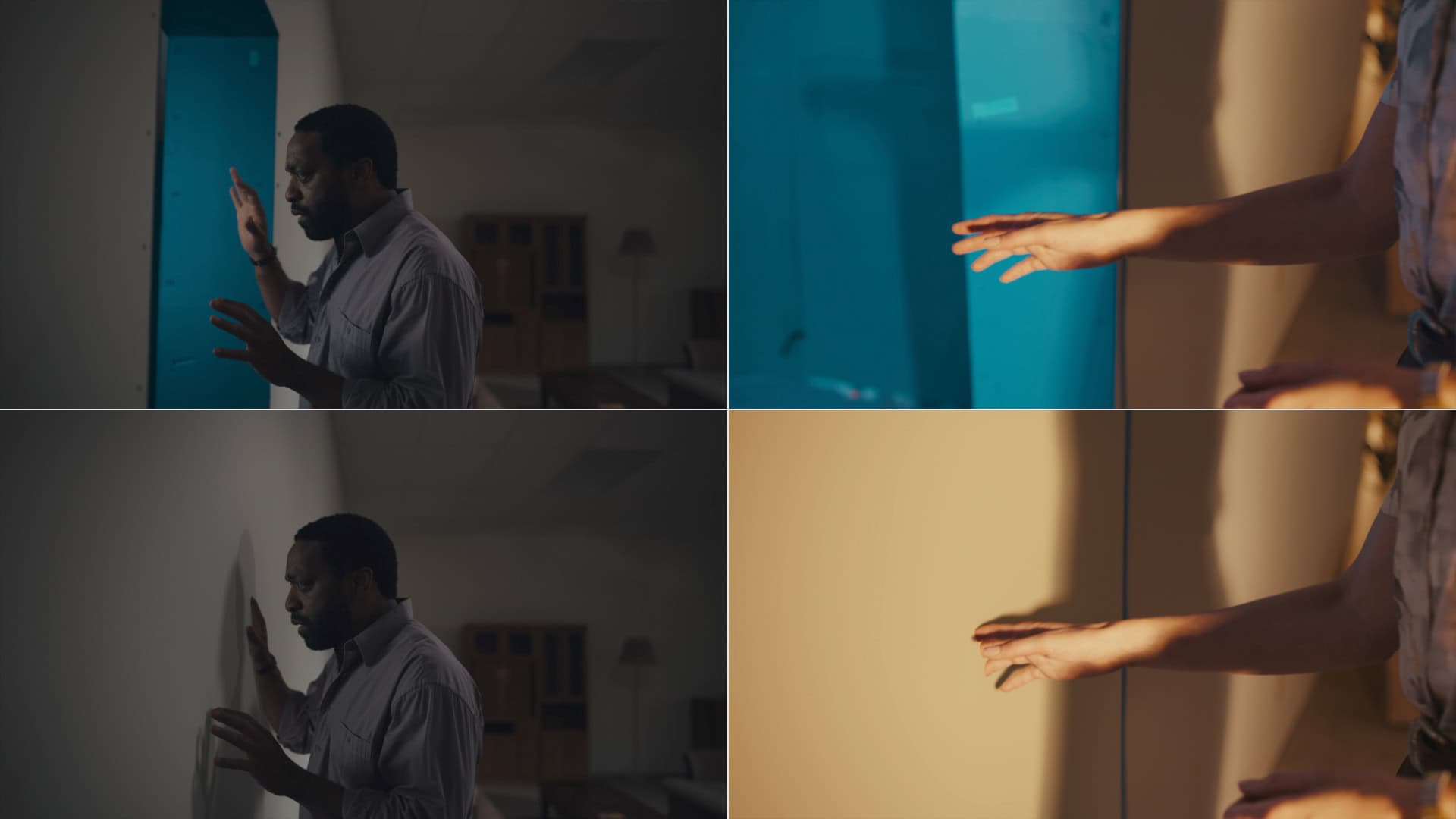
To shoot Clark’s entry to the Backrooms, the team built two sets right next to each other: Cap’n Clark’s Ottoman Empire’s basement and the first Backrooms space with the big furniture pile. A hole in the wall was made for crossing the two realities, which they coined “the null zone”. “We filmed the basement with dark lighting and a blue screen on the other side. [Chiwetel Ejiofor, who plays Clark] would walk to the wall and touch it so we could see how the shadows behaved, then we would do a pass where we pulled up the plug so he could go right up to it and fall through. We set up witness cameras so we could see what that exact intersection point would be, then in post, the work was: Step one, add the CG wall back in; Step 2, a rotomation of the character based on the witness cameras so we knew where the actor was in relationship to the wall, then build an actual CG clipping and refine it with rotoscope by hand; Step 3, what really glued it all together was the shadows. Every shadow on that CG wall has to also be CG … They were all reprojected from our rotomated characters, matching the lighting in the space.” He revealed that Mary’s crossing was similar, except they chose a side scroller shot, and that for the wall clipping the characters were always from the plate: “We’re subtracting rather than adding. We did the CG rotomation that we needed to project the shadows from them, but otherwise they’re always real.”
The Vertigo Room and the Indoor Suburban Street
As Mary escapes from the terrifying Pirate Clark entity, the audience discovers new areas of the Backrooms, including the vertigo room: a tight walkway leading to gravity-defying stairs over seemingly endless drop, only one way out through an unconventionally tiny door. Douglas said that the scene was the perfect candidate for VFX: “We prevised early on to understand how deep it would go, pitching that camera over to feel that nausea-inducing drop. Then anything the actors interacted with we built: a little L-shaped set with a ceiling, the stairs with the door that would fall, and the door that Pirate Clark was bashing on. Everything else would be extended [in post-production]–filling the space with blue screen. We took a moment thinking, ‘How much can we build procedurally?’ Pretty quickly we realized the Backrooms are so specific, and Kane wanted to art direct the angles and the moments in such detail that the procedural only got us so far. We had tools where we could build walls and floor and ceilings very quickly, but the directing of these spaces really was manual.” Then for the drop, “we thought, ‘Do we want to see the bottom or not?’ We introduced a little bit of haze, so you couldn’t actually see it. We’re not saying it goes on infinitely because the Backrooms are not a non-Euclidean space–it behaves with real world rules. The job was filling out that space and helping you imagine the sheer variety of Backrooms spaces you could have in there. And then when Mary goes up and grabs the door, it falls down to the stage floor. We did a CG takeover of that door and continued the animation, the physics simulation of it falling all the way until it disappears into the depths.”
Mary’s escape was even more surreal after learning that the indoor suburban street (which was a Backrooms interpretation of Bobby and Kat’s neighborhood) was actually an outdoor set with lighting to simulate an indoor one. This scene was part of the earliest production conversations Edward Douglas had with lead producer Chris Ferguson, brainstorming on how to approach the fairly short scene, and because of the sheer size of the space, “it would have been an absolutely enormous set to build … we didn’t have stages with that kind of height or floor space, and if we did, it would mean we’d lose quite a few other sets, so it had to be a real exterior that we were going to have to do VFX on. The only way we found that we could light it and feel right and match the Backrooms overhead lighting was to do a night-for-day exterior-for-interior, which I don’t know if anyone else has ever done that before.”
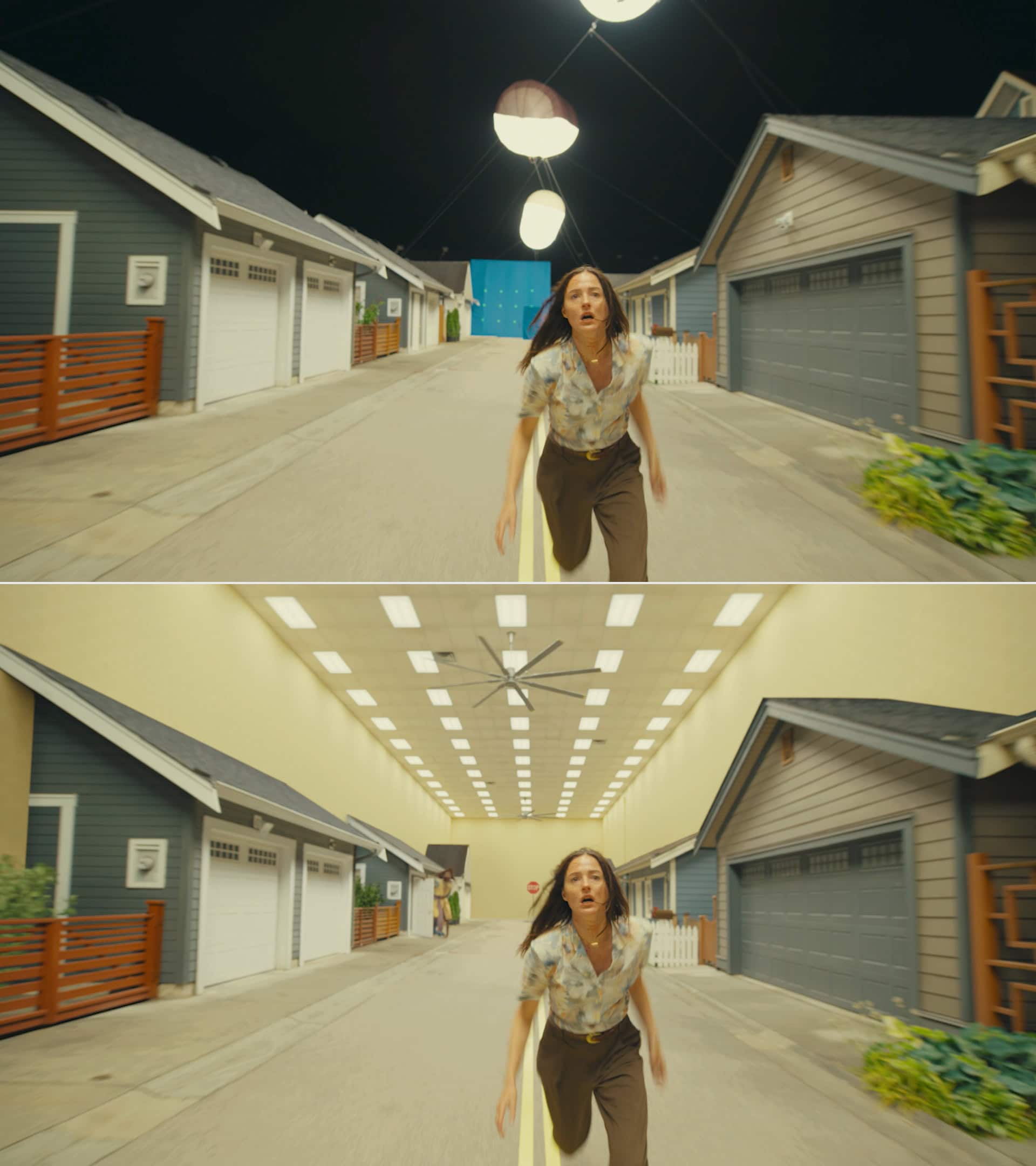
The location was an alley in one of the neighboring cities to Vancouver that had these rows of garages, which Douglas explained had “this repeated surreal quality to it.” The production design team replaced most of the garage doors with fake house fronts with windows, adorning each one with little picket fences, bushes and trees. To reproduce the fluorescent light, the team mounted big, floating lighting balloons. The weather forecast for shooting day and the short seasonal night hours made it a nightmare to plan, but in the end the storm did not come in, and when they got into post-production and started adding the walls to the room, “we discovered that the lighting was so perfect. There was a little bit of paint outs for some of the wires on the balloons that were attached to houses, but we did a scan of the entire neighborhood, which gave us a geometry of all the houses. Then we could build the mattes for putting the walls in based on those scanned geometries. The walls went in, the ceiling went in, and it started looking right very quickly. It was pretty incredible how quickly it just all came together because Jeremy, the DOP and the lighting team nailed that lighting so beautifully, which made the VFX job quite a bit easier than it could have been.” The VFX for this particular scene were done in Blender, which Kane Parsons himself helped dial in to fit perfectly into the Backrooms world.
With over 10 minutes of full CG, Backrooms has so many more invisible VFX that helped enrich its visual storytelling. In retrospect, Edward Douglas felt incredibly privileged to have worked on such an original project with a director who had such a clear vision and is looking forward to seeing what the future of Backrooms might bring.
For more insights on the VFX of Backrooms, join the conversation at VIEW Conference 2026 October 12–16 in Turin, Italy.